Trip Report: Customized Birding Tour in Guatemala (28 December 2007 - 3 January 2008)
by Robert Orenstein
Summary
Claudia Avendaño and Knut Eisermann organized a one week custom tour for Pacific slope bird specialties and the cultural attractions of colonial Antigua and Lake Atitlán. This was my third visit to Guatemala, my first being a four day trip to the Biotopo del Quetzal in 1992 and my second being a short visit to Tikal earlier this year, so I was eager to see the Pacific side of the country. We visited several prime birding locations over a seven day period, with an emphasis on several regional endemics that I had missed on my previous trips to Guatemala and Chiapas.
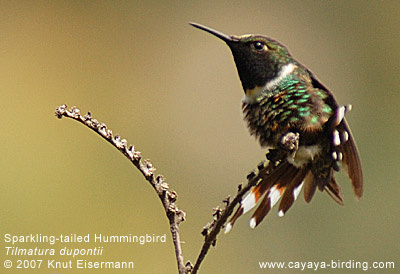
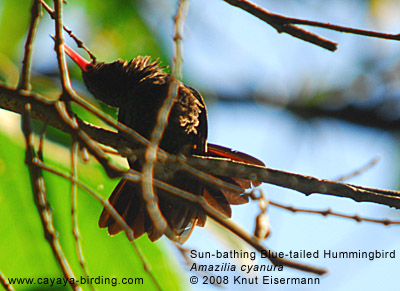
Hummingbirds were much in evidence throughout, with nineteen species seen; as well as leks of several, including Sparkling-tailed; and a Blue-tailed sunning in the forest at Los Tarrales that looked like it was having a spa treatment! Other highlights were a group of three Azure-rumped Tanagers above Vesubio; and White-bellied Chachalaca, Long-tailed Manakin, three species of parakeet, and swarms of wintering Red-Legged Honeycreepers near the lodge at Los Tarrales. The other highlands visited produced outstanding views of Blue-throated Motmot, Gray Silky-flycatcher, Brown-backed Solitaire, Rufous-collared Robin, Blue-and-white Mockingbird, and Pink-headed Warbler. Classy birds in classy surroundings!
Knut was an outstanding guide and personable companion. His knowledge of the birds is encyclopedic, and his sharp eyes and perseverance were greatly appreciated. The country is growing rapidly, but all of the people we encountered were extremely friendly and accommodating. Most of the remaining habitat for birds such as the Azure-rumped Tanager is on privately-owned land, and ecotourism is both good for the local economies and critical to protecting the remaining habitat. Moreover, the private reserves provide quiet and safe places to observe birds and other wildlife – much different than most of the situations I encountered in Chiapas. I am planning to bird other parts of Guatemala with Knut, and to keep returning, as many bird species are locally distributed and/or have seasonal movements that only someone living in the area can be thoroughly familiar with.
201 total species (32 heard only)
ITINERARY
Day 1, Dec 28: Cerro Alux (late afternoon), evening in Antigua
Day 2, Dec 29: Finca El Pilar (morning), Cerro Tecpan & Panajachel (afternoon), evening in Panajachel
Day 3, Dec 30: Panajachel (morning), Finca Los Tarrales (afternoon), evening in Los Tarrales lodge
Day 4, Dec 31: Los Tarrales Nature Reserve (early morning), Vesubio to Los Tarrales (morning, afternoon), evening in Los Tarrales lodge
Day 5, Jan 1: Los Tarrales Nature Reserve (morning), Pachuj Nature Reserve (afternoon), evening in Los Tarrales lodge
Day 6, Jan 2: Los Tarrales Nature Reserve (early morning), Finca El Pilar (afternoon), evening in Antigua
Day 7, Jan 3: Cerro Alux (morning), evening in Guatemala City
BIRDING SITES
Cerro Alux: A small reserve near Guatemala City that protects a nice patch of mature high elevation (2200 m) pine-oak forest. There are several well-maintained trails through the forest, as well as clearings with restrooms and picnic facilities. Although heavily used on weekends, late afternoon and early morning visits produced excellent views of Band-tailed Pigeon, White-tipped Dove, White-eared Hummingbird, Green-throated Mountain-gem, Blue-throated Motmot, Guatemalan Flicker, Tufted Flycatcher, Greater Pewee, Hammond’s and Yellowish Flycatchers, Rose-throated Becard, Steller's and Bushy-crested Jays, Band-backed Wren, Eastern Bluebird, Brown-backed Solitaire, Rufous-collared Robin, Blue-and-white Mockingbird, and Black-headed Siskin. There was also a small sampling of wintering vireos and wood-warblers, including several Ovenbirds which were unexpected. A fine stop to begin or end a tour (we did both).
Finca El Pilar: A small coffee plantation near Antigua with hummingbird feeders and a new trail cut into the side of a steep ravine. We spent a morning near the feeders and an afternoon on the trail, which produced an impressive list of mid-elevation (1500-1800 m) species. The trail is about 1 km long, but gains about 300 meters in elevation and has numerous stairs and boardwalks which are at eye level to the treetops in places, allowing unparalled opportunities to observe foraging flocks. We took a circular route on our second visit, walking up a well maintained road to the upper trail access, which produced several Brown-backed Solitaires, Hammond’s Flycatchers and a large flock of Gray Silky-flycatchers for our effort. Several large mixed flocks of various species of wood-warblers, vireos, flycatchers, thrushes, wrens, woodpeckers, woodcreepers, and hummingbirds were seen on the trail itself, and at least two Highland Guans were calling and wing-rattling very close to the lower part of the trail, but unfortunately never seen.
Cerro Tecpan: A high elevation (2500+ m) pine-oak forest east of Lake Atitlán which is easily accessed near a roadside restaurant. Although the forest is partially logged and used by the local people, during a mid-afternoon visit we readily observed Blue-throated Motmot, White-eared and Amethyst-throated Hummingbirds, and three lovely Pink-headed Warblers accompanied by Spot-crowned Woodcreepers, Slate-throated Redstarts, and Crescent-chested, Red-faced and Golden-browed Warblers. Mountain Trogon called briefly but was not seen.
Panajachel: A coffee plantation and riparian area near Panajachel. The habitat is primarily dry scrub. A late afternoon visit produced White-throated Swift, Violet-green and Northern Rough-winged Swallows, a calling Great Horned Owl, and a leucistic Band-backed Wren that looked very funny as it foraged in plain view; but the main attraction was a lek of at least five male Sparkling-tailed Hummingbirds that Knut discovered only two months earlier. These hummingbirds breed in winter and are very elusive at other times of the year, so this was definitely the bird of the trip for me. We returned the following morning and found Rusty and Lincoln’s Sparrows, but the hummingbirds once again stole the show! Wow!!!
Los Tarrales Nature Reserve: A large ornamental plant and coffee plantation on the southern slope of the Atitlán volcano. This is one of the prime ecotourism destinations in the region, with very comfortable accommodations in several newly renovated buildings and excellent trails though forest ranging in elevation from 760-2500 m. Some of the lower trails have interpretive signs that identify the plant species, and are home to a wide variety of lowland and mid-elevation birds; including regional endemics such as White-bellied Chachalaca, Pacific Parakeet, and Long-tailed Manakin. Another memorable sight were the 500+ wintering Red-Legged Honeycreepers on one trail near the lodge. However, the star attractions are found on the upper trails, above the small settlement of Vesubio, as both Horned Guan and Azure-rumped Tanager are resident. The guan requires an early morning hike to about 2400 m which we did not attempt, as I had seen this bird previously. We walked up to about 1800 m one morning and were rewarded with lekking Emerald-chinned Hummingbird, a very confiding Scaly-throated Foliage-gleaner, and scope views of three feeding Azure-rumped Tanagers spotted by Knut.
Pachuj Nature Reserve: A large coffee plantation near Los Tarrales that is being considered for ecotourism but has not yet been developed as such. There is extensive bamboo at about 1500 m elevation, and we spent one afternoon searching fruitlessly for Slaty Finch (Knut had seen a female there about one month earlier). A pair of Bar-winged Orioles in a flock of eight Baltimore Orioles and other assorted frugivores saved the day!
BIRD LIST
(H) - heard only
- Great Egret Ardea alba
- Cattle Egret Bubulcus ibis
- Black Vulture Coragyps atratus
- Turkey Vulture Cathartes aura
- Gray Hawk Asturina nitida
- Short-tailed Hawk Buteo brachyurus
- Red-tailed Hawk Buteo jamaicensis
- Ornate Hawk-Eagle Spizaetus ornatus
- Collared Forest-Falcon Micrastur semitorquatus (H)
- Laughing Falcon Herpetotheres cachinnans (H)
- American Kestrel Falco sparverius
- White-bellied Chachalaca Ortalis leucogastra
- Crested Guan Penelope purpurascens
- Highland Guan Penelopina nigra (H)
- Singing Quail Dactylortyx thoracicus (H)
- Spotted Sandpiper Tringa macularia
- Rock Pigeon Columba livia
- Band-tailed Pigeon Patagioenas fasciata
- Red-billed Pigeon Patagioenas flavirostris
- White-winged Dove Zenaida asiatica
- Inca Dove Columbina inca
- Common Ground-Dove Columbina passerina
- White-tipped Dove Leptotila verreauxi
- White-faced Quail-Dove Geotrygon albifacies
- Pacific Parakeet Aratinga strenua
- Orange-fronted Parakeet Aratinga canicularis
- Orange-chinned Parakeet Brotogeris jugularis
- Yellow-naped Parrot Amazona auropalliata
- Squirrel Cuckoo Piaya cayana
- Great Horned Owl Bubo virginianus (H)
- Mottled Owl Ciccaba virgata (H)
- Ferruginous Pygmy-Owl Glaucidium brasilianum (H)
- Lesser Nighthawk Chordeiles acutipennis
- Pauraque Nyctidromus albicollis
- Chestnut-collared Swift Streptoprocne rutila
- White-collared Swift Streptoprocne zonaris
- Vaux's Swift Chaetura vauxi
- White-throated Swift Aeronautes saxatalis
- Rufous Sabrewing Campylopterus rufus
- Violet Sabrewing Campylopterus hemileucurus
- White-necked Jacobin Florisuga mellivora
- Green-breasted Mango Anthracothorax prevostii
- Emerald-chinned Hummingbird Abeillia abeillei
- Blue-throated Goldentail Hylocharis eliciae
- White-eared Hummingbird Hylocharis leucotis
- White-bellied Emerald Amazilia candida
- Azure-crowned Hummingbird Amazilia cyanocephala
- Blue-tailed Hummingbird Amazilia a cyanura
- Berylline Hummingbird Amazilia beryllina
- Cinnamon Hummingbird Amazilia rutila
- Amethyst-throated Hummingbird Lampornis amethystinus
- Green-throated Mountain-gem Lampornis viridipallens
- Magnificent Hummingbird Eugenes fulgens
- Long-billed Starthroat Heliomaster longirostris
- Sparkling-tailed Hummingbird Tilmatura dupontii
- Ruby-throated Hummingbird Archilochus colubris
- Mountain Trogon Trogon mexicanus (H)
- Collared Trogon Trogon collaris
- Tody Motmot Hylomanes momotula (H)
- Blue-throated Motmot Aspatha gularis
- Blue-crowned Motmot Momotus momota
- Green Kingfisher Chloroceryle americana
- Emerald Toucanet Aulacorhynchus prasinus
- Acorn Woodpecker Melanerpes formicivorus
- Golden-fronted Woodpecker Melanerpes aurifrons
- Hairy Woodpecker Picoides villosus (H)
- Golden-olive Woodpecker Piculus rubiginosus
- Guatemalan (Northern) Flicker Colaptes auratus
- Lineated Woodpecker Dryocopus lineatus
- Pale-billed Woodpecker Campephilus guatemalensis
- Rufous-breasted Spinetail Synallaxis erythrothorax
- Scaly-throated Foliage-gleaner Anabacerthia variegaticeps
- Ruddy Foliage-gleaner Automolus rubiginosus (H)
- Tawny-throated Leaftosser Sclerurus mexicanus (H)
- Ivory-billed Woodcreeper Xiphorhynchus flavigaster
- Spotted Woodcreeper Xiphorhynchus erythropygius
- Spot-crowned Woodcreeper Lepidocolaptes affinis
- Barred Antshrike Thamnophilus doliatus (H)
- Northern Beardless-Tyrannulet Camptostoma imberbe
- Greenish Elaenia Myiopagis viridicata
- Yellow-bellied Elaenia Elaenia flavogaster
- Paltry Tyrannulet Zimmerius vilissimus
- Northern Bentbill Oncostoma cinereigulare (H)
- Common Tody-Flycatcher Todirostrum cinereum (H)
- Eye-ringed Flatbill Rhynchocyclus brevirostris (H)
- Yellow-olive Flycatcher Tolmomyias sulphurescens (H)
- Tufted Flycatcher Mitrephanes phaeocercus
- Greater Pewee Contopus pertinax
- Tropical Pewee Contopus cinereus
- Yellow-bellied Flycatcher Empidonax flaviventris (H)
- Least Flycatcher Empidonax minimus
- Hammond’s Flycatcher Empidonax hammondi
- Yellowish Flycatcher Empidonax flavescens
- Dusky-capped Flycatcher Myiarchus tuberculifer
- Brown-crested Flycatcher Myiarchus tyrannulus
- Great Kiskadee Pitangus sulphuratus (H)
- Boat-billed Flycatcher Megarynchus pitangua
- Social Flycatcher Myiozetetes similis
- Tropical Kingbird Tyrannus melancholicus
- Western Kingbird Tyrannus verticalis
- Rose-throated Becard Pachyramphus aglaiae
- Masked Tityra Tityra semifasciata
- Long-tailed Manakin Chiroxiphia linearis
- Yellow-throated Vireo Vireo flavifrons
- Blue-headed Vireo Vireo solitarius
- Hutton's Vireo Vireo huttoni
- Warbling Vireo Vireo gilvus
- Brown-capped Vireo Vireo leucophrys
- Lesser Greenlet Hylophilus decurtatus
- Green Shrike-Vireo Vireolanius pulchellus (H)
- Rufous-browed Peppershrike Cyclarhis gujanensis (H)
- Steller's Jay Cyanocitta stelleri
- White-throated Magpie-Jay Calocitta formosa
- Bushy-crested Jay Cyanocorax melanocyaneus
- Gray-breasted Martin Progne chalybea
- Violet-green Swallow Tachycineta thalassina
- Black-capped Swallow Notiochelidon pileata
- Northern Rough-winged Swallow Stelgidopteryx serripennis
- Barn Swallow Hirundo rustica
- Bushtit Psaltriparus minimus
- Brown Creeper Certhia americana
- Band-backed Wren Campylorhynchus zonatus
- Rufous-naped Wren Campylorhynchus rufinucha
- Spot-breasted Wren Thryothorus maculipectus (H)
- Rufous-and-white Wren Thryothorus rufalbus (H)
- Plain Wren Thryothorus modestus
- (Southern) House Wren Troglodytes aedon
- Rufous-browed Wren Troglodytes rufociliatus
- Gray-breasted Wood-Wren Henicorhina leucophrys (H)
- Long-billed Gnat-Wren Ramphocaenus melanurus (H)
- Blue-gray Gnatcatcher Polioptila caerulea
- Eastern Bluebird Sialia sialis
- Brown-backed Solitaire Myadestes occidentalis
- Orange-billed Nightingale-Thrush Catharus aurantiirostris
- Swainson's Thrush Catharus ustulatus
- Hermit Thrush Catharus guttatus (H)
- Clay-colored Robin Turdus grayi
- White-throated Thrush Turdus assimilis
- Rufous-collared Robin Turdus rufitorques
- Tropical Mockingbird Mimus gilvus
- Blue-and-white Mockingbird Melanotis hypoleucus
- Gray Silky-flycatcher Ptilogonys cinereus
- Olive Warbler Peucedramus taeniatus (H)
- Blue-winged Warbler Vermivora pinus
- Tennessee Warbler Vermivora peregrina
- Nashville Warbler Vermivora ruficapilla
- Crescent-chested Warbler Parula superciliosa
- Yellow Warbler Dendroica petechia
- Magnolia Warbler Dendroica magnolia
- Black-throated Green Warbler Dendroica virens
- Townsend's Warbler Dendroica townsendi
- Black-and-white Warbler Mniotilta varia
- Ovenbird Seiurus aurocapilla
- Louisiana Waterthrush Seiurus motacilla
- MacGillivray’s Warbler Oporornis tolmiei
- Wilson’s Warbler Wilsonia pusilla
- Red-faced Warbler Cardellina rubifrons
- Pink-headed Warbler Ergaticus versicolor
- Slate-throated Redstart Myioborus miniatus
- Golden-crowned Warbler Basileuterus culicivorus
- Rufous-capped Warbler Basileuterus rufifrons
- Golden-browed Warbler Basileuterus belli
- Yellow-breasted Chat Icteria virens
- Common Bush-Tanager Chlorospingus ophthalmicus (H)
- Red-crowned Ant-Tanager Habia rubica (H)
- Summer Tanager Piranga rubra
- Western Tanager Piranga ludoviciana
- Flame-colored Tanager Piranga bidentata
- White-winged Tanager Piranga leucoptera
- Blue-gray Tanager Thraupis episcopus
- Yellow-winged Tanager Thraupis abbas
- Azure-rumped Tanager Tangara cabanisi
- Red-legged Honeycreeper Cyanerpes cyaneus
- White-collared Seedeater Sporophila torqueola
- Chestnut-capped Brush-Finch Buarremon brunneinucha (H)
- Prevost's Ground-Sparrow Melozone biarcuatum
- White-eared Ground-Sparrow Melozone leucotis
- Rusty Sparrow Aimophila rufescens
- Lincoln's Sparrow Melospiza lincolnii
- Rufous-collared Sparrow Zonotrichia capensis
- Grayish Saltator Saltator coerulescens
- Black-headed Saltator Saltator atriceps
- Rose-breasted Grosbeak Pheucticus ludovicianus
- Indigo Bunting Passerina cyanea
- Painted Bunting Passerina ciris
- Melodious Blackbird Dives dives
- Great-tailed Grackle Quiscalus mexicanus
- Bronzed Cowbird Molothrus aeneus
- Black-vented Oriole Icterus wagleri
- Bar-winged Oriole Icterus maculialatus
- Orchard Oriole Icterus spurius
- Altamira Oriole Icterus gularis
- Baltimore Oriole Icterus galbula
- Yellow-billed Cacique Amblycercus holosericeus (H)
- Scrub Euphonia Euphonia affinis
- Yellow-throated Euphonia Euphonia hirundinacea
- Elegant Euphonia Euphonia elegantissima
- Blue-crowned Chlorophonia Chlorophonia occipitalis (H)
- Black-headed Siskin Carduelis notata
- Lesser Goldfinch Carduelis psaltria
- House Sparrow Passer domesticus
Robert Orenstein, Atlanta, Georgia, USA.