City birds in Cobán
Cobán is a small town at 1300 m elevation nestled in the hilly karst landscape. Some of the time writing up results from our bird research in Guatemala I spend in Cobán, where my desk window provides view to a hillside with shrubby gardens with some tall avocado trees and banana plants, a little pine stand, some tall Roystonea royal palms, and a tall stand of an introduced Asian bamboo.
At dawn during the main breeding season, before the city noise picks up, flocks of Black-headed Saltators sing their noisy choruses, Melodious Blackbirds perform their dance songs, and Yellow-backed Orioles sing their sweet song. Rusty Sparrow and Prevost's Ground-Sparrow sing in the shrubby and open areas. Sometimes a Strong-billed Woodcreepers can be heard singing its dawn song in the pine stand. As the day advances, subtle bird voices such as calls of Yellow-winged and Blue-gray tanagers become buried under the noise of cars and trucks passing by, street sellers announcing with their loud voice newspapers, ice cream, chocolate bananas, and empanadas.
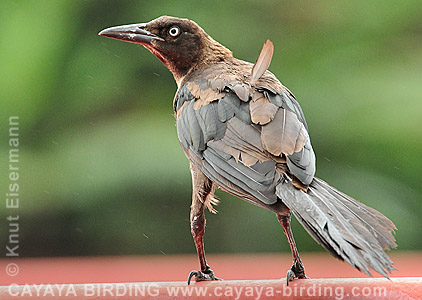
Apparently unimpressed by the human-made noises, birds keep communicating. Great-tailed Grackles trumpet their strange songs from the roofs, Rufous-collared Sparrows sing from the wires, Golden-fronted, Golden-olive, and Lineated Woodpeckers call from the trees. Once in a while the duets of Band-backed Wrens and the loud song of Rufous-browed Peppershrike can be heard.
At the same time of the year Chestnut-headed Oropendulas start looking for a suited tree to establish their nesting colony. Once the large pendular nests are built, oropendulas can be seen all day long flying back and forth between the nest site and feeding grounds in trees where they feed on everything they can reach with their large bills, including fruit, nectar, insects and their larvae, but also vertebrates including nestlings of other bird species.
At times a Bat Falcon uses the towering Royal Palms as perch to dive after large flying insects. Large and noisy flocks of White-collared Swift pass through frequently, as do flocks of Olive-throated Parakeet.
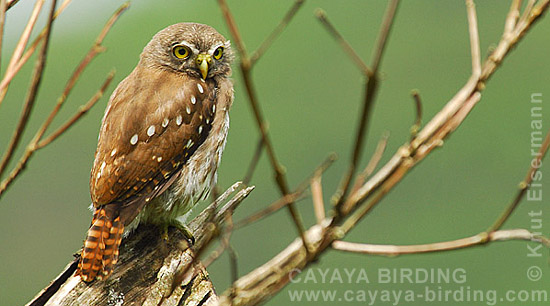
At night Cobán becomes very quite again, with almost no human-made noises, which makes nocturnal wildlife well audible from my desk. Cobán nights belong to a number of owl species. The hissing call of Barn Owl flying over the town can often be heard. The gardens are softly illuminated by the street lights, of which Ferruginous (Ridgway's) Pygmy-Owls take advantage. This owl is active mainly during diurnal and crespular hours, but probably the artificial lighting in front of my desk window is stimulating intensive nocturnal vocalizations at the beginning of the breeding season. Early in the year, a pair of Great Horned Owl is hooting on the hillside, and sometimes even perched in solitary trees in the patios of the neighboring houses. Mottled Owl, the most widespread and common owl in Guatemala, also hoots occasionally in the gardens. During spring and fall migration of Nearctic-Neotropical migratory birds, the night-air over Cobán is filled with calls of flying migrants passing high over the city, such as Swainson's Thrush.
Tours and research give me much time in the field, and the panorama from my desk, which allows to see and hear some birds throughout day and night, makes even office duties enjoyable.
Knut Eisermann