Motagua valley
The middle valley of the Motagua river is the hottest and driest regions of Guatemala, and indeed, the driest area of Central America. Located on the lee side of the Sierra de las Minas mountain chain, just little precipitation reaches the Motagua valley. The area receives less than 500 mm of annual rainfall, which is just enough for a scanty vegetation: thorn scrub and dry forest with a 3-5 m tall canopy. Characteristic plants are spiny shrubs, cactus species, including tall columns, acacias, and Guayacan trees (Guiacum sanctum).
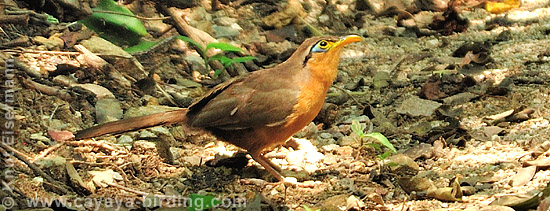
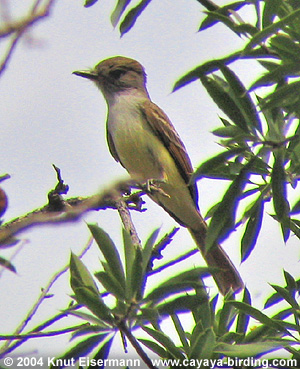
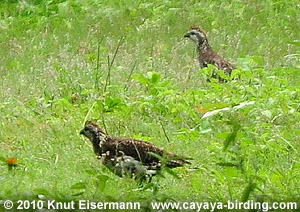
There are several bird species specialized on the thorn scrub and dry forest, such as Spott-bellied Bobwhite, Russet-crowned Motmot, Lesser Roadrunner, Lesser Ground-Cuckoo, Plain-capped Starthroat, Nutting’s Flycatcher, White-lored Gnatcatcher, Stripe-headed Sparrow, and Streak-backed Oriole. The Turquoise-browed Motmot is one of the most prominent bird species. Also Altamira and Spot-breasted Orioles, Rufous Hummingbird, Orange-fronted Parakeet, Common Ground-Dove, White-throated Magpie-Jay, and Rufous-naped Wren are residents of the valley. Banded Wren and Elegant Trogon occur locally. Western Kingbird and Ash-throated Flycatcher winter in the area.
Lesser Nighthawks leave their day roost at dusk to hunt aerial insects over the thorn scrub. The song of Buff-colored Nightjar can be heard locally, as well as calls of Great Horned Owl and Vermiculated Screech-Owl. The most common owl of the Motagua valley is the Ferruginous Pygmy-Owl.
Two recently established protected areas in the Motagua valley invite for a birding walk in thorn scrub and dry forest, one in the department of Zacapa, and one in the department of El Progreso. Parque Regional Municipal Niño Dormido is located near the little town of Cabañas, 30 km west of the town of Zacapa. The park has a size of 180 ha and has been established especially to protect habitat of the Beaded Lizard (Heloderma horridum), locally called Niño Dormido. A loop trail of about 1.5 km length traverses dry forest and thorn scrub at 300-450 m elevation. The Parque Regional Municipal Lo de China is located 3 km west of Parque Niño Dormido and has a loop trail of 1 km length.
How to get there and accommodation: Visits to the preserves require previous communication with the tourism office at the municipality of Cabañas for the Niño Dormido park, and the municipality of El Jícaro for the Lo de China Park. Both sites are accessible on paved road from Santa Cruz (Zacapa). Hotels are available in Santa Cruz (Zacapa).
When is the best time for a visit to Motagua valley? Birding is good year round.
How do you support conservation and development in Motagua valley? The thorn scrub and dry forest of the Motagua valley are threatened due to intensive land use, such as cattle farming, fruit production (melon, water melon), and unsustainable firewood harvest. With your birding visit to the “Niño Dormido” and “Lo de China” protected areas you put an economic value to the thorn forest, which will help to motivate local people to protect this kind of forest. The reserves are part of the Sierra de las Minas - Motagua Important Bird Area (IBA GT012).