Totonicapán
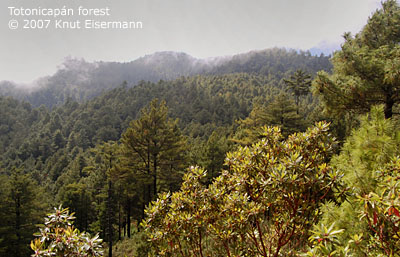
The city of San Miguel Totonicapán, at an elevation of 2500 m in the western Guatemalan highlands has not yet been discovered by international tourists. Around the city you find a landscape of corn fields, villages and conifer forests with different pine species (Pinus spp.), cypress (Cupressus lucitanicus) and Guatemalan Fir (Abies guatemalensis). In humid valleys the forest is mixed with broadleaf trees (oak, alder). The area is home to several bird species endemic to the northern Central American highlands.
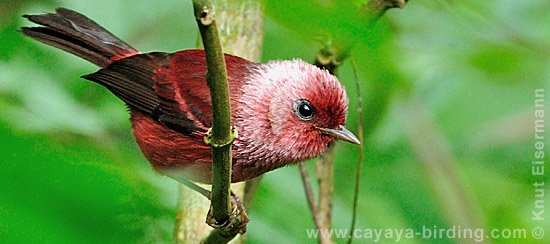
Soon after entering the forest the distinct ch-lip call reveals the presence of Pink-headed Warbler, an endemic of the highlands of Guatemala and Chiapas. Even without being familiar with the calls, birders can detect this beautiful warbler quite easily, because it moves not just in the canopy, but also in the forest understory. The bird is locally quite common in the Guatemalan highlands and there is no need to climb steep volcanoes to observe this species. During a birding morning in the Totonicapán conifer forest in September 2007 we detected more than 15 Pink-headed Warblers. In each mixed foraging flock one to three individuals moved together with Townsend's, Hermit, Wilson's, Olive, Golden-browed, and Crescent-chested Warblers, Hutton's Vireo, Golden-crowned Kinglet, Brown Creeper, and Spot-crowned Woodcreeper.
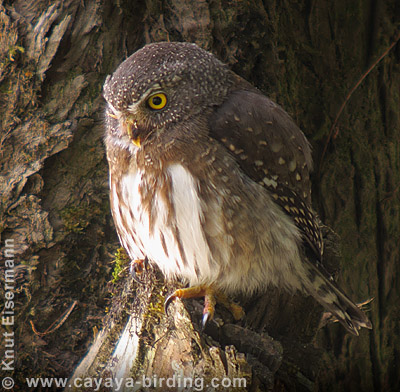
In addition to Pink-headed Warblers, we observed several other endemics of the northern Central American highlands during a day's visit in the Totonicapán conifer forest. Rufous-browed Wren and Rufous-collared Robin were common, and Black-capped Swallow flew overhead. We also heard Ocellated Quail.
In the forest understory we detected several Chestnut-capped Brushfinches, Yellow-eyed (Guatemalan) Juncos, Spotted Towhees, and Ruddy-capped Nightingale-Thrushes. Singing Quail was heard at the distance. Most common hummers were Amethyst-throated and White-eared Hummingbird. Several flocks of Gray Silkies, Chestnut-collared Swift, and Vaux's Swift flew overhead. Flocks of noisy Steller's Jays roamed through the forest.
The Totonicapán forest covers an area of more than 16,000 ha and is one of the largest tracts of high-elevation conifer forest in Guatemala. The main part of the forest is communal, and some adjacent sections are privately owned.
Accommodation: San Miguel Totonicapán is the capital of the province Totonicapán. The city is easily accessible via the Panamerican highway. Hotels are available in the city. If you are ready for camping, you may also stay in the rustic huts of Sendero El Aprisco, which is right on the forest edge.
When is the best time for a visit to Totonicapán? The forest can be birded year round.
How do you support conservation and development in Totonicapán? By visiting the forest of Totonicapán you help to establish a sustainable forest use, alternative to the extraction of timber and firewood. Totonicapán is part of the Atitlan Important Bird Area (IBA GT015), designated by BirdLife International.