Sanimtacá at Montaña Sacranix
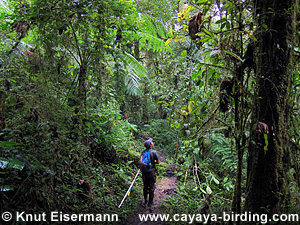
Sanimtacá is a small Maya Q'eqchi' village 15 km west of Cobán, Alta Verapaz. The Sacranix Important Bird Area (IBA GT007) stretches between Cobán in the east and the Chixoy river in the west, and includes 200 km2 of primary humid broadleaf forest. The area offers the rare opportunity to hike along an altitudinal transect and see the vegetation changing from cloud forest at 1600 m to lowland rain forest at 400 m. PROEVAL RAXMU Bird Monitoring Program has recorded more than 300 bird species in Sacranix.
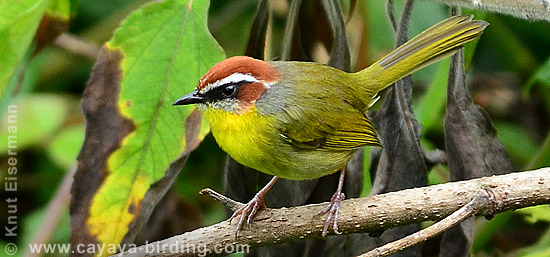
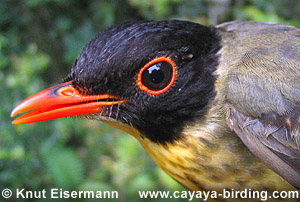
The birds are obvious indicators of different forest types. Entering the cloud forest at 1600 m early in the morning, whistles and wing rattle of Highland Guans are all around, and the beautiful song of the Slate-colored Solitaire is the most dominant of the dawn chorus. Sudden calls of the Resplendent Quetzal will make you search for this jewel in the moist green. Noisy flocks of Azure-hooded Jays wander through the forest. The plaintive call of the Blue-crowned Chlorophonia carries far through the canopy. Grey-breasted Wood-Wrens are singing in duet in the undergrowth. More inconspicuous but common species in this cloud forest are Yellowish Flycatcher, Eye-ringed Flatbill, and Paltry Tyrannulet. Mixed-species flocks led by Common Bush-Tanagers are often joined by Scaly-throated Foliage-gleaner and Slate-throated Redstart. The Green-throated Mountain-Gem is the most common hummingbird in the cloud forest of Sacranix.
Hiking down slope you will notice a change at 1200 m elevation. Trees are not laden with mosses anymore and you will listen to voices which were absent in the upper forest. Red-crowned Ant-Tanager, Yellow-throated Euphonia, Bananaquit and Olivaceous Woodcreeper are some of the typical lowland species. The White-bellied Wood-Wren joins the occurrence of the Grey-breasted, until this species is lacking completely farther down-slope. The altitude around 1200 m is very species rich because of the transition between different bird communities. There the Slaty Antwren is seen frequently in mixed-species flocks. Also the Shining Honeycreeper has been observed here.
As you descent the mountain, temperature rises, and the bird community gains more and more elements of lowland rainforests. In 600 m elevation you will find a typical Atlantic Slope lowland bird community. But a few birds of the cloud forest, mainly the Slate-colored Solitaire und the Common Bush-Tanager are still present, but in low density.
How to get there and accommodation: A visit to the Sacranix cloud forest can be organized as day tour from the city of Cobán, where a number of hotels are available.
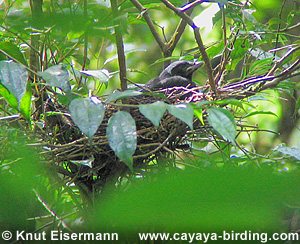
When is the best time for a visit in Sanimtacá? March to June, which is the main breeding season.
How do you support conservation and development in Sanimtacá and Sacranix? Several conservationist organizations are working together with the small Maya Q'eqchi' communities in the area in order to promote sustainable development and the conservation of the forest. With your visit you will provide an income the forest owning community. This demonstrates the importance of the forest as source for an alternative income. For more information about continuous bird monitoring and conservation at Montaña Sacranix visit PROEVAL RAXMU Bird Monitoring Program. The area has been designated as Sacranix Important Bird Area (GT007).